
why california natives?

California natives often get a bad rap for being brown and sticky... not like that though! In celebration of 2026 being the year of "Backyard Ecology," we want to remind you that your garden isn't just a yard; it's a "pollinator pathway" that supports local birds, butterflies, and bees.

Bright green lawns maintained with chemicals always look strange in the middle of our dry season. Gardens with California natives use 80% less water than a traditional lawn. Though we recommend irrigating to limit the brown effect, especially while plants are establishing, swapping that old weed lawn and sprinklers with natives on drip irrigation can save on the water bill and help save this shared and precious resource.
When designed properly, a native landscape has a wonderfully natural look and can require less maintenance than other gardens. And, if you are concerned about fire, a well designed native landscape can actually protect your home from the dangers of wild fires.
You're curious about which California natives are our favorite to use in the garden? We call these our "Usual Suspects" ...


Manzanita: Genus Arctostaphylos ... Red bark, evergreen, beautiful structure, and a variety of leaf sizes and shades. For upright larger manzanitas we love 'Dr. Hurd' and 'St. Helena' for their larger leaves and silver foliage. Check out 'Louis Edmunds' or 'Howard McMinn' with smaller and brighter green leaves and pink flowers. For a groundcover manzanita, we love 'Carmel Sur.' A beautiful feature of all manzanita is the support pollinators in winter months when other plants are resting.
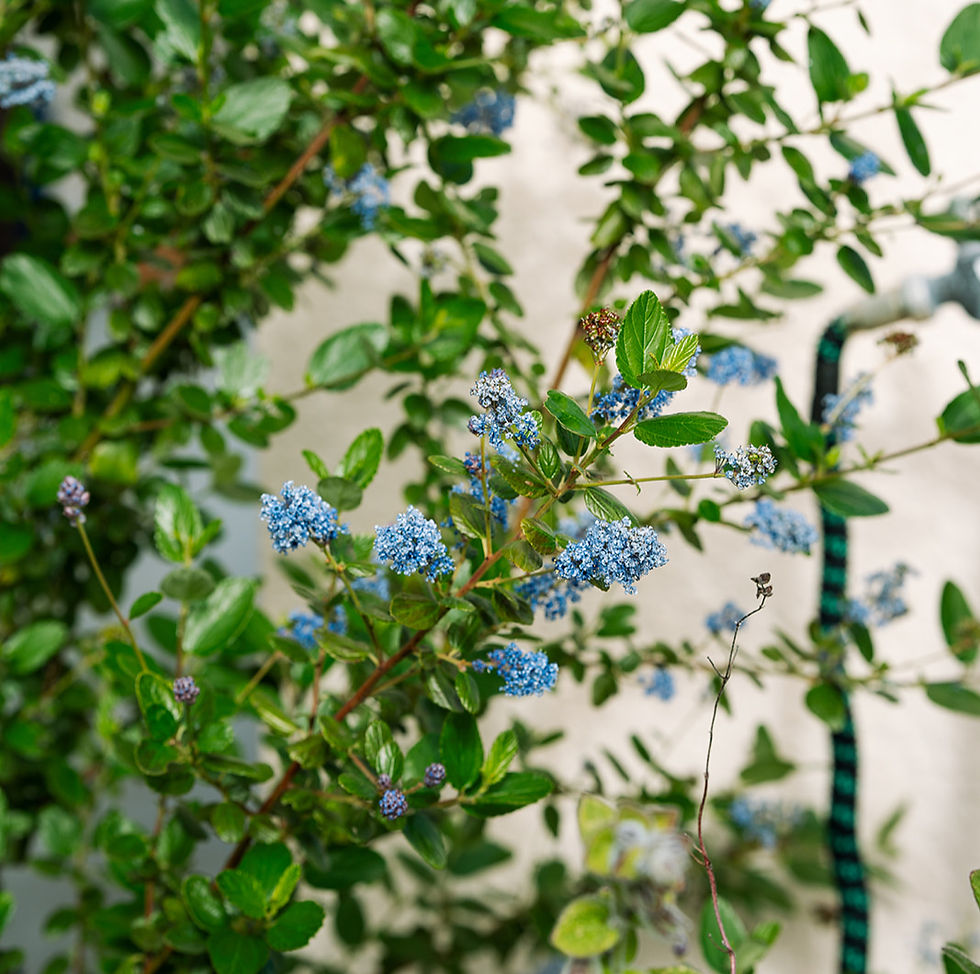
Ceanothus: Another evergreen favorite that ranges from tree size to groundcover. With a late winter early spring flowering, these beautiful blue and purple blooms make the bees go nuts. The contrast beautifully with the likes of silver leafed purle and white sage. Like the manzanita, they have a variety of leaf sizes too. They love the sun and prefer less water. Some of our favorites? 'Concha' has a nice large rounded shape with that classic blue-purple blossom. 'Blue Jeans' stays a little smaller with lighter shade of purple bloom, despite it's name. 'Owlswood Blue' is known to tolerate shade better than others. If purple isn't your flavor, 'Snowball' has white blooms. Try 'Skylark' for a tidy garden size of 4'. Our go-to groundcover Ceanothus are 'Yankee Point, 'Anchor Bay,' and Hearst's Ceanthous for that tiny narrow leaf. Deer love Ceanothus as much as we do ... try the varieties with smaller leaves for a less delicious option.


Salvia: What a genus! Although many of the Salvias you find at the garden center are non-native ... there are some wonderful native options. Our favorites: Black Sage (Salvia mellifera) is native to Santa Cruz county and does excellent here, but she will want some space to grow (6'+) Purple Sage (Salvia leucophylla), native to counties just south of us, has a more silver leaf and gets even larger than the Black Sage. Salvia clevelandii comes in some fun cultivars: 'Winnifred Gillman,' 'Pozo Blue,' and 'Allen Chickering.' Our favorite hybrid is 'Desperado' as it has dramatically large flowers ... but it can be hard to find! And don't forget White Sage (Salvia apiana) has incredibly silver fragrant leaves with beautiful stalks of white flowers. It even comes in a Compact option! For low growing ground covers, check out 'Mrs. Beard,' 'Terra Seca,' or 'Bee's Bliss.' You've got some shade? Hummingbird Sage (Salvia spathacea) can tolerate some shade and has incredible pink blooms that the hummingbirds go nuts for.

Coffeeberry: For shadier gardens or under Redwoods, try evergreen Coffeeberry. Our favorite variety is 'Eve Case.' The birds will thank you.
Other shade options include: Toyon, Chain Fern, and Flowering Currant.

Grasses: The number one go-to for us is Festuca californica with green blue foliage and a tinge of purple and beautiful seed stalks. Be careful, because they can have some prolific seeds. Our other favorite grass is Deer Grass (Muhlenbergia rigens). It gets a bit larger than California fescue, but has a distinct seed head that looks beautiful when planted en masse. We could go on about grasses, but we will leave it there for now!

Other favorites include Island Alum root (Heuchera maxima), Western Redbud, Douglas Iris, Bee Balm, Yarrow, and all the wonderful Buckwheats (Eriogonum). Don't forget to toss some Clarkia seed and California Poppy Seed around the garden either!
Check out www.calscape.org to learn more about native plants and even get design ideas!
Which native plant are you most excited to try this season? Or do you have a favorite local nursery? Let’s share resources in the comments!


Comments